How to Talk to Your Audiologist

It was a busy day at the Sanderson Community Center with over 300 people attending the yearly egg hunt however we still had good attendance for our meeting in spite of worrying over parking issues.  The steering committee showed up extra early with coffee, Einstein Bagels and juice.  We socialized for about 45 minutes, seeing a few members we haven’t seen in a while which was a delight!  It was one of our best meetings.

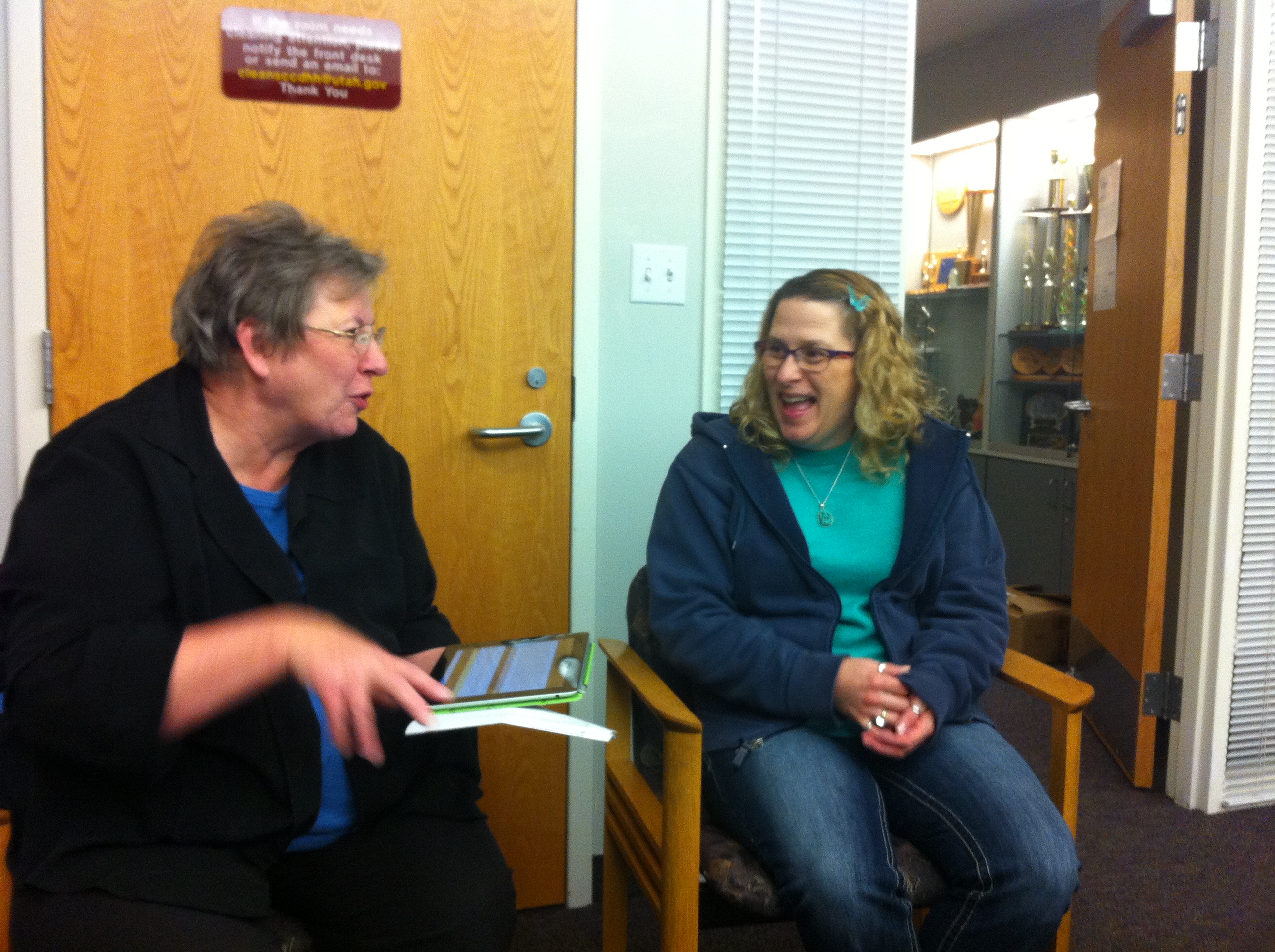
Lisa starting off the meeting.

Lisa starting off the meeting.

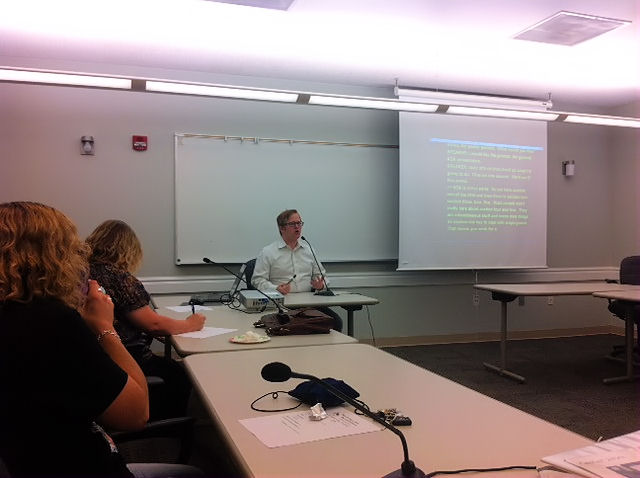
Lisa Dahlstrom, AuD from the University of Utah, was our presenter and our topic was “How to Talk to Your Audiologist.”  She started us with common questions that should be asked  on your first and why they ask them.

When did hearing loss start?  Does anyone else in the family have hearing loss? that clues her in on if it’s congenital or not.

Is it in one ear or both ears?  One ear can be red flag for something wrong like tumors.

Ear surgeries?  Looking to see if the eardrum might be damaged.

Tinnitus? With dizziness? If the tinnitus came on suddenly or is in one ear only, that’s a red flag for tumors.  She asks about dizziness and then wants to know if it’s a tipping over feeling or is the whole room spinning?  If it’s a tipping over feeling, she will send people to the neurologist.  If it’s the room spinning, she pursues Meniere’s disease.

Have you been around loud noises?  People often don’t know what those loud noises are and they will typically say no but when she asks about their hobbies things turns up like hunting and use of power tools.

About 95% of the people have peripheral hearing loss which is more to the outside: conductive hearing loss, sensorineural, hereditary, trauma, ototoxic and age related hearing loss.

The other kind of hearing loss is retro cochlear, inside the head which is more serious: brain or nerve damage, mini stroke in the vessels around the ear, MS, acoustic tumors and enlarge vestibular aqueducts.

Lisa told us that what we tell her about how we hear, helps adjust her to adjust our hearing aids.  If we bring audiologist a list of specific noises that we think we are missing or what sounds we don’t like helps audiologists make better program adjustments to hearing aid programs.  Things like:

  • When the dishwasher comes on, it seems to shut down my hearing aids.
  • When riding in the car, the road noise shuts down my hearing aids or I only hear the road noise in cars.
  • I can’t follow the conversation with the clerk in the grocery store.
  • Traffic noises is too loud.
  • When I’m in a quiet settings I have troubles following conversation.

I even once complained that chopping vegetables on the cutting board had me grinding my teeth it was so uncomfortable.  Lots of things can be adjusted once we specify what’s bothering us. With today’s digital hearing aids, these adjustments can be made: gain, frequency response, compression, noise suppression, directional mic, t-coil, wireless and  speech enhancement.

She talked a little on the differences between audiologists and hearing instrument specialists.  She ended the meeting saying she like to tell family, “Always give the person with a hearing loss the benefit of the doubt.  Don’t think they are ignoring you or not paying attention.”

After the meeting the steering committee met to talk about upcoming meetings.  May is Better Speech and Hearing month.  We will be joining Loop Utah at one of the first venues to be looped in celebration.  More details on when and where will be coming soon.

In July we will have a picnic in the Millcreek area with tips on socializing with hearing loss leading up to the event.

In September the topic will be Hearing Loss and Health issues with Kathy Evans and Marilyn Call presenting.  We will a couple going to the National HLAA convention in Missouri in June reporting on their experience.   That’s bound to be a super meeting as well!

For November, we will talk about our favorite technology and share how it works.  We will also feature wireless technology and present apps for smart phones that work for hearing loss.

How to Talk to Your Audiologist: March 21, 2015

  Our next meeting is March 21st at the Sanderson Center from 9-11am in classroom B/C.  We have CART and the Hearing Loop.  We have a great topic for you and a wonderful presenter so save the date and visit with us.
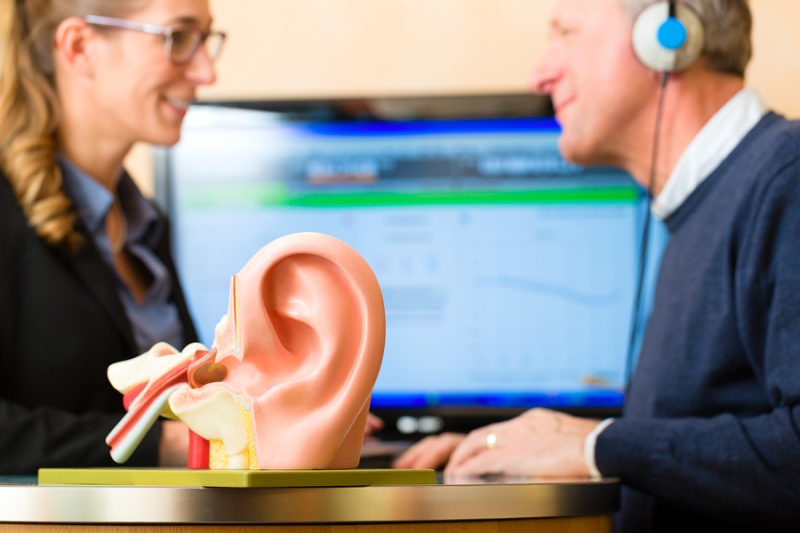
Picture from the Phonak website.

Picture from the Phonak website.

  Our topic this month is: How to Talk to Your Audiologist.
Gain some idea on how to better prepare for those meetings when your hearing aid or cochlear implant will be tuned up, how to bring up the problems you are having and how much you can actually expect them to improve your listening experiences.
  Bring your questions to our meeting featuring Lisa Dahlstrom AuD from the University of Utah Otolaryngology/ENT Division.  She’s worked with hearing aids and she works with cochlear implants.  She has answers.  We hope to see you there.
By the way, the picture above came from this website:  http://communityblog.phonak.com/2014/07/10/your-audiologist-a-life-long-relationship/
It’s a good read so check it out.

The HLAA Book Club: From Wild to Pope Joan

The HLAA book club met at the Sanderson Center last Saturday to discuss Wild: From Lost to Found on the Pacific Coast Trail by Cheryl Strayed.

We were all awed by her journey, Monster (her backpack) and we still wonder how she accomplished it with all the problems with her feet.  We talked about the little black frogs, the bow hunters, the tragedy with her mothers horse, and more.  We came up with some great insights too such as perhaps Monster represented the emotional weight she carried since her mother’s death.  The condition of her feet may represent how much her heart as well.

Our next book, chosen by Kathy is Pope Joan by Donna Woolfolk Cross.

pope joan

We will discuss this book Saturday April 18th at the Sanderson Center in classroom B/C with the hearing loop and CART.  Anyone can join us.

Here’s a short review from Amazon: For a thousand years men have denied her existence–Pope Joan, the woman who disguised herself as a man and rose to rule Christianity for two years. Now this compelling novel animates the legend with a portrait of an unforgettable woman who struggles against  restrictions her soul cannot accept.

When her older brother dies in a Viking attack, the brilliant young Joan assumes his identity and enters a Benedictine monastery where, as  Brother John Anglicus, she distinguishes herself as a scholar and healer. Eventually drawn to Rome, she soon becomes enmeshed in a dangerous mix of powerful passion and explosive politics that threatens her life even as it elevates her to the highest throne in the Western world.

“Brings the savage ninth century vividly to life in all its alien richness. An enthralling, scholarly historical novel.”
–Rebecca Fraser, Author of The Brontës

This book is based on a legend, learn more at wikipedia.

HLAA-SLC Book Club meeting February 21st

The HLAA-SLC book club had a great time discussing What Dreams May Come by Richard Matheson earlier this month.  The discussion was rich and made us all think about life.  Thank you for the suggestions Cheri.

20150107_191 20150107_192

We chose February’s book, Wild: From Lost to Found on the Pacific Coast Trail by Cheryl Strayed, being shown in theaters now staring Reese Witherspoon.  The book was features in Oprah’s book club and the movie is now up for a few Academy Awards.

Wild2014Poster

Anyone is welcome to come, even if you haven’t read the book, come join our discussion.  The meeting will be held at the Sanderson Center in classroom C with a hearing loop and CART as accommodations.  Here’s a list of questions we’ll be going over (gathered from Random House).

1. “The Pacific Crest Trail wasn’t a world to me then. It was an idea, vague and outlandish, full of promise and mystery. Something bloomed inside me as I traced its jagged line with my finger on a map” (p. 4). Why did the PCT capture Strayed’s imagination at that point in her life?

2. Each section of the book opens with a literary quote or two. What do they tell you about what’s to come in the pages that follow? How does Strayed’s pairing of, say, Adrienne Rich and Joni Mitchell (p. 45) provide insight into her way of thinking?

3. Strayed is quite forthright in her description of her own transgressions, and while she’s remorseful, she never seems ashamed. Is this a sign of strength or a character flaw?

4. “I knew that if I allowed fear to overtake me, my journey was doomed. Fear, to a great extent, is born of a story we tell ourselves, and so I chose to tell myself a different story from the one women are told” (p. 51). Fear is a major theme in the book. Do you think Strayed was too afraid, or not afraid enough? When were you most afraid for her?

5. Strayed chose her own last name: “Nothing fit until one day when the wordstrayed came into my mind. Immediately, I looked it up in the dictionary and knew it was mine . . . : to wander from the proper path, to deviate from the direct course, to be lost, to become wild, to be without a mother or father, to be without a home, to move about aimlessly in search of something, to diverge or digress” (p. 96). Did she choose well? What did you think when you learned she had assigned this word to herself—that it was no coincidence?

6. On the trail, Strayed encounters mostly men. How does this work in her favor? What role does gender play when removed from the usual structure of society?

7. What does the reader learn from the horrific episode in which Strayed and her brother put down their mother’s horse?

8. Strayed writes that the point of the PCT “had only to do with how it felt to be in the wild. With what it was like to walk for miles for no reason other than to witness the accumulation of trees and meadows, mountains and deserts, streams and rocks, rivers and grasses, sunrises and sunsets” (p. 207). How does this sensation help Strayed to find her way back into the world beyond the wilderness?

9. On her journey, Strayed carries several totems. What does the black feather mean to her? And the POW bracelet? Why does she find its loss (p. 238) symbolic?

10. Does the hike help Strayed to get over Paul? If so, how? And if not, why?

11. Strayed says her mother’s death “had obliterated me. . . . I was trapped by her but utterly alone. She would always be the empty bowl that no one could fill” (p 267). How did being on the PCT on her mother’s fiftieth birthday help Strayed to heal this wound?

12. What was it about Strayed that inspired the generosity of so many strangers on the PCT?

13. “There’s no way to know what makes one thing happen and not another. . . . But I was pretty certain as I sat there that night that if it hadn’t been for Eddie, I wouldn’t have found myself on the PCT” (p. 304). How does this realization change Strayed’s attitude towards her stepfather?

14. To lighten her load, Strayed burns each book as she reads it. Why doesn’t she burn the Adrienne Rich collection?

15. What role do books and reading play in this often solitary journey?

January 17th Meeting: Self-Advocacy

Our next meeting is just 10 days away on January 17th from 9am-11am at the Sanderson Center for the Deaf and Hard of Hearing.  The meeting is hearing accessible with CART and a hearing loop.  Our topic this month is Self-Advocacy.

I (Chelle) attended a Deaf Advocacy Workshop last October and we can apply a lot of that to hard of hearing advocacy. Here’s some of what I’m going to share with you during my presentation:

  • How to advocate
  • Ways to self-advocate
  • Self-esteem and self-determination
  • Preparing for Self-Advocacy

Bring your family and friends or come because you know someone who is hard of hearing and could use a little help.

HLAA Book Club: What Dreams May Come

Our next HLAA book club gathering is on Dec. 13th from 9am-10:30.  It will be at the Sanderson Center in Classroom C with the hearing loop and CART.

What Dreams May Come

The next book being discussed is “What Dreams May Come” by Richard Matheson.  It’s on Kindle for $8.89, there’s used on Amazon starting at $1.50 and it can be ordered through the library too.  Click HERE for the Amazon link.  Even if you haven’t read the book come on in as the discussion are a lot of fun.  Come help us pick out the next book for February.  (The book club alternates with the HLAA bi-monthly meetings.)  Here’s the questions that will lead the discussion….

Describe a situation where you have felt a feeling of a presence. Who do you believe it was? Why do you believe they were there? If you have never felt such a thing, describe one someone you know has experienced. How does this affect your belief in an afterlife?

How is Ann’s refusal to believe in Chris’s afterlife existence affecting her and her family? Explain how she is affecting the belief of her children.

How does Summerland compare with the typical concept of heaven? Explain.

Discuss why souls that have evolved, such as Albert and Leona, are still in Summerland.

Is Ann’s suicide a predictable plot point? Why or why not?

Is suicide as wrong for someone not in his or her right mind? Explain.

Discuss free will and Ann’s suicide. Use your arguments from Albert’s position and from Chris’s position.

Multiple Choice Questions

  1. Why does Ann want Richard to stop trying to console her?
    (a)She wants to have time to find Chris alone.
    (b) It only makes her feel worse.
    (c) She thinks he is coming on to her.
    (d) She does not believe Chris is alive in spirit.
  1. Who do Leona and Chris met?
    (a)A man who will find out what Chris wants to know.
    (b) An angel.
    (c) God.
    (d) Chris’s mother.
  1. What place does Chris visit?
    (a)The Hall of Unbelievers.
    (b) The Hall of Literature.
    (c) The Hall of Religious Theory.

(d) The Hall of Good and Bad Deeds.

  1. Who writes a letter about Chris?
    (a)Ann.
    (b) His daughter, Marie.
    (c) Richard.
    (d) Ian.
  1. What do the damned do in the vacuum of Hell?
    (a) Live pretty much the way they’ve always lived.
    (b) Talk to themselves about the same things over and over.
    (c) Ponder non-spiritual matters.
    (d) Plot revenge against God.

Short Answer Questions

  1. Who is with Ann?
  1. How do the works of literature exist in this library?
  1. When is Ann to join Chris in Summerland?
  1. Why is it hard for Ann to believe that Chris is still alive in some form?
  1. How does Chris’ heart beat?

November 15, 2014 Meeting

It’s about time for our next meeting!  It will be at the Sanderson Center for the Deaf and Hard of Hearing in the conference room from 9am-11am.  CART will be available.

With the holidays coming up, we thought we’d cover Holiday Blues.

holidayblues

Depression is a common feeling during the holidays and it’s even more common among those with hearing loss.  As Marilyn Call says in her “Grief” workshop, “Feelings not felt…STAY.  Feel what you are feeling.  Becoming aware of a feeling and letting yourself feel it somehow neutralizes it.”  Reach out at our meeting and learn how others cope with it.

The group discussion will be led by Dr. Susan Chilton the first hour.  There will be a short break afterward and the second hour will be devoted to HLAA-SLC business.  Learn what’s going with your chapter and in the area.

Meeting Notes from Sept. 20, 2014

Karen, our new HLAA chapter president, began the meeting just a little after 9:00 last Saturday morning.  Our meeting was set up with CART and the hearing loop making for easy hearing access for everyone.

Our guest speaker was Jared Allebest who has a specialty in Americans with Disabilities Act (ADA).  He gave a short presentation on the ADA featuring the different aspects.  Title 1 applies to businesses with 14 or more employees.  Title 2 which applies to places like city hall, court, prison and the police.  Title 3 covers public places such as apartments (flashing door bells) and businesses we may go to (flashing fire alarms) and other businesses such as movie theaters with captioning access.

Jared Allebest

Jared Allebest

He took questions from attendees ranging from park and recreation services (if they take money from the federal government they need to comply with the ADA), tenant laws, jury duty, renters rights and using captioned phones to document conversations.

He coached us on writing  letters of accommodation to businesses:

  • Ask about their policy and then proceed with knowledge
  • State your disability
  • state your need
  • write it at least 3 days in advance though 7 days is best

You can email questions to Mr. Allebest about ADA concerns at jared@allebest.com and he will answer within a week or so.  If you need help writing a letter for reasonable accommodation, he can help with for a small fee.

For more on the ADA, try this link: http://www.ada.gov/cguide.htm.  It lists phone numbers, addresses and websites.

During the meeting Karen also told us about the HLAA Convention last June in Austin, TX.  She shared her experiences and the workshops she attended.  Chelle later shared her experiences with the SayWhatClub Convention in Madison, WI last July.

Thanks to all who attended!  Our next meeting is Nov. 15th and the topic will be holiday depression.